Food Systems as Regional Economic Development
Improving access to affordable, nutritious food is an obvious public health benefit. However, many fail to consider how regionally and/or locally controlled food systems can be an economic asset for building and retaining wealth. EDDs should work to create the planning, financing, workforce, and business support conditions needed to create and retain food system assets in communities.
Several U.S. Department of Agriculture (USDA) research studies commissioned over the past 20 years show that local food systems can have an outsized economic impact on their local communities relative to the amount of investment initially made by local or state governments. Low et al. (2015) compiled a comprehensive literature review of several economic impact studies done on regional and local food systems which provide key evidence that consumer demand for locally produced foods is growing¹. National sales from direct marketing channels of local foods grew from $511 million in 1997 to $8.7 billion in 2015 ¹. A University of Wisconsin-Madison study, in partnership with the Food Market Coalition, found that 2.2 jobs are created for every $100,000 in local food sales.
Having food value chains rooted in communities can create new avenues and opportunities for local entrepreneurs to build their businesses and make connections with other locally owned businesses. Building these relationships can create a web of interconnected entrepreneurs whose local networks can reduce logistics costs, provide higher quality services to customers, retain value in communities, and support new jobs.
Source: Agriculture and Local Food Economies in the Appalachian Region, prepared by Karen Karp and Partners (KK&P), in partnership with the Appalachian Regional Commission (ARC) (2022).
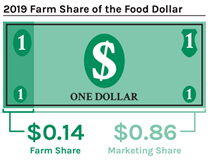
The above graphic displays the relationship between producers and other levels of the food supply chain with farmers receiving only $0.14 of every $1 spent on food in the U.S.$0.86 of every $1 spent on food in the U.S. is then earned by the marketing portion of the supply chain. Shifting this ratio towards a higher share of each dollar reaching local producers should be one of the main focuses of EDDs’ work to support the development of regional and local food systems. As local and regional food systems are strengthened, more local food system entrepreneurs are supported, and more producers, distributors, processors and retailers are rooted in these communities and regions, a larger share of that $1 spent on food will remain in those communities.
Food systems are a valuable area for investment as they have vast multiplier impacts on local jobs and local private investment beyond the market, farm, or processor. A USDA study found that local food systems have an economic multiplier on jobs of 1.78-1.41, meaning that for every job created in local food systems, an additional 0.78 to 0.41 jobs are created in other economic sectors in the region. Schmit et al. (2013) found that local food hubs can have an economic multiplier impact ranging from 1.82 to 1.63 for every dollar invested ². Local and regional food hubs will be discussed in later sections. In a 2021 study conducted by Tennessee State University with support from USDA, researchers found that local food systems in Tennessee have an average income multiplier of 2.56 and a value-added multiplier of 2.06 ³. These numbers are only expected to grow as consumer demand for locally produced foods continues to grow across the country.
These multiplier effects make ‘import substitution,’ the consumer habit of sourcing goods from local sources instead of importing the same good from other areas, all the more important for growing regional and local economies. Greater demand for these goods creates the economic conditions necessary for those regionally or locally owned producers, processors, and retailers to expand and grow their businesses in communities. Successful regional food systems provide benefits to both rural and urban areas. Higher demand for locally produced goods in rural and urban areas further strengthens regional economic connections between rural areas and urban areas of a region, shifting needed capital and private investment towards rural areas. This is the crux of regional wealth creation that will be discussed in future sections.
¹ Low, Sarah A., Aaron Adalja, Elizabeth Beaulieu, Nigel Key, Steve Martinez, Alex Melton, Agnes Perez, Katherine Ralston, Hayden Stewart, Shellye Suttles, Stephen Vogel, and Becca B.R. Jablonski (2015, January). Trends in U.S. Local and Regional Food Systems, AP-068, U.S. Department of Agriculture, Economic Research Service. https://www.ers.usda.gov/webdocs/publications/42805/51173_ap068.pdf?v=2018.5
² Schmit, T.M., B.B.R. Jablonski, and D. Kay.(2013, September). “Assessing the Economic Impacts of Regional Food Hubs: the Case of Regional Access.” Cornell University. http://dx.doi.org/10.9752/MS145.09-2013
³ Ajayi, O., Ekanem, E., & Mafuyai, M. (2021, March). Economic Contributions of the Local Food Systems in Tennessee. https://www.fdrsinc.org/wp-content/uploads/2021/05/JFDR52.1_4_Ajayi.pdf
Michael Matthews is the Director of Government Relations for the National Association of Development Organizations (NADO), where he leads congressional and executive branch outreach, coalition building, and advocacy efforts on behalf of more than 500 regional development organizations (RDOs) nationwide.
With over a decade of experience, Michael combines policy expertise with political acumen to advance federal policies that promote equitable community development, economic competitiveness, rural growth, economic mobility, and quality of place. Before joining NADO, he served as the Legislative Director for Community, Economic & Workforce Development at the National Association of Counties (NACo), collaborating with county officials to shape policies affecting local governments in areas such as housing, community and economic development, public works, and workforce initiatives.
Earlier in his career, Michael held various policy positions at the Association for Career and Technical Education (ACTE), Office of Congressman Anthony G. Brown (D-Md.), and contributed to several political campaigns across the Washington, D.C. metro area.
Michael holds a bachelor’s degree in political science from Salisbury University and a master’s degree in public administration from Wilmington University. A native of Delaware, he now resides in Lake Ridge, Virginia, with his wife and daughter.
Ryan Collins joined NADO in 2024. He lives in Athens, Ohio, and is passionate about ensuring rural communities thrive and prosper across the country. Ryan has always identified as a helper and has focused his career on serving others in both the public and private sectors. Before joining NADO, Ryan worked as a Policy Manager with the National Digital Inclusion Alliance. There he focused on Federal Policy issues and making them more accessible to members.
Ryan also worked with NADO-member organization, Buckeye Hills Regional Council (BHRC). There he served as a Broadband Coordinator and then as a Program Manager leading Ohio’s Southeast Regional Digital Inclusion Alliance, managing BHRC’s State and Federal Appalachian Regional Commission programs, and working in several other programs.
In his free time, Ryan enjoys reading, playing Dungeons and Dragons along with Magic the Gathering, building models, hiking, and spending time with his children (his cats Saturn and Cosmo).
Andrew Coker joined the NADO team in March of 2023 as a Regional Development Researcher after spending two and a half years as the Regional Economic Resiliency Coordinator at NADO-member organization West Central Arkansas Planning and Development District.
Now serving at NADO as a Program Manager, Andrew conducts research on the newest economic and community development best practices from Economic Development Districts across the country. He helps produce easily digestible information on complex regional issues through case studies, tip sheets, and research reports. Andrew also hosts training and professional development opportunities including conference sessions and virtual webinars for member regional development organizations.
Andrew holds a bachelor’s degree from Hendrix College and a master’s degree from the University of Arkansas Clinton School of Public Service. He is one of NADO’s three Missouri-based team members and enjoys reading and training for his next triathlon.
As Director of Programs, Jack Morgan manages the portfolio of NADO’s training, research, capacity-building, and other grant-funded programs and activities of the NADO Research Foundation. Jack previously served as a NADO Senior Program Manager and Associate Director, leading work supporting energy communities and the training programs for Emerging Leaders.
Jack joined the NADO team in 2022 after seven years with the National Association of Counties (NACo) as a Program and Senior Program Manager. Prior to NACo, Jack was a Policy Analyst for Friends of Southwest Virginia and interned for Mount Rogers Planning District Commission (VA). Jack holds a bachelor’s in geography from Emory & Henry College and a master’s in geography from Appalachian State University.
Jack is certified by the American Institute of Certified Planners (AICP) and is a member of the American Planning Association (APA) Regional & Intergovernmental Planning Division. He also serves on the Emory & Henry College Alumni Board.
Taking road trips, reading non-fiction, and indulging in top-notch barbecue and coffee round out Jack’s days. He loves maps, mountains, and of course, all things sports.
Kar’ron Grant joined the NADO team in 2023 as Administrative Specialist and is the first face (or voice) you’ll see or hear when reaching out to NADO. As Administrative Specialist, Kar’ron manages our database and coordinates NADO event operations. He ensures members’ needs are met, contact information stays current, and NADO’s office is running efficiently.
Kar’ron came to NADO after four years in the classroom teaching at The New Century School and Old Mill Middle North where he received the Patriot of the Year award. He attended Towson University and the University of Maryland Global Campus and holds a bachelor’s in international studies and humanities.
Visiting art galleries and museums, playing basketball and bowling, and taking in movies and music are some of Kar’ron’s interests and hobbies.
Deputy Executive Director Laurie Thompson has been with NADO for 25 years. Laurie helps keep the NADO and NADO Research Foundation wheels turning through management of the daily operations of the Research Foundation, securing financial resources and overseeing grants management, and helping execute NADO’s Annual Training Conference each year.
Laurie holds a bachelor’s in public affairs and government from Mount Vernon College and a master’s in health services administration from The George Washington University. Prior to NADO, Laurie spent time as a Field Specialist and an Eagle Staff Fund Director at First Nations Development Institute.
When she’s taking a rare reprieve from her NADO work, Laurie enjoys traveling domestically and internationally to visit friends and family.
Jamie McCormick joined the NADO team as a Policy Fellow in 2019 and now serves as a Senior Manager of Member Services. In this role, she supports NADO’s engagement with its membership, helping ensure members stay connected, informed, and supported. She assists with programs, communications, and events that strengthen relationships across the organization’s network.
Brett Schwartz began at NADO in 2012 as a Research Fellow after earning his J.D. from the University of Baltimore School of Law. The following year, he was promoted to Program Manager and has now been leading as an Associate Director since 2018. Brett is responsible for managing NADO’s Economic Development District Community of Practice (EDD CoP), as well as researching and monitoring the latest trends in regional economic development and resilience, including best practices for the Comprehensive Economic Development Strategy (CEDS). With more than a decade of experience on the NADO team, Brett is a dynamic relationship builder helping connect and build capacity among the national network of regional development organizations.
Brett also holds a bachelor’s degree from Georgetown University and a master’s from Trinity College Dublin, as well as a certificate in mediation training. He’s a member of Catalyst Grantmakers of San Diego and Imperial Counties and was a participant in the 2021-22 Field Trips to the Future Cohort.
Brett is one of NADO’s West Coast team members residing in San Diego, CA where he enjoys spending time outdoors, attending concerts and festivals, and soaking up life as a parent of two young children.
Katie Allison joined the team in 2023 to lead the strategic communication efforts of NADO. Katie creates and develops print and online materials, communicates NADO’s updates to members via weekly emails, and maintains content for nado.org and NADO’s social media channels. She also works with different departments to generate new ideas and strategies to effectively describe and promote the important work NADO is doing for EDDs and RDOs across the country.
An experienced nonprofit communications professional, Katie worked for organizations in western North Carolina for nearly a decade. She holds a bachelor’s in communications from Wingate University where she was a four-year student athlete.
Senior Program Manager Ciara Ristig has been a member of the NADO team since 2021, and helps with NADO’s EDD Community of Practice, EDD staff capacity building and other grants on a range of subjects, including equity and solar energy. Before NADO, Ciara worked as a Planner for the County of Santa Barbara and an Assistant Project Manager for REM Consult. Ciara holds a bachelor’s in urban studies and French from Bryn Mawr and a master’s in urban studies from Ecole d’Urbanisme de Paris.
When she’s not traveling, you can find her outrigger paddling and serving on the board of the Blue Sky Center in New Cuyama, CA, near her home base of Santa Barbara.
Carrie Kissel has been a member of the NADO team since 2005 and currently serves as Associate Director, Transportation. Carrie holds a bachelor’s in anthropology from Ball State University and a master’s in public anthropology from American University. In her role at NADO, Carrie provides technical assistance and support to rural regions on transportation and economic development issues. She also develops training and peer exchange events on transportation issues and rural wealth creation as an economic development strategy.
Carrie is a member of the Transportation Research Board (TRB) and serves as chair of the TRB Standing Committee on Transportation in Rural Areas.
Reading, gardening, hiking, and kayaking are a few of Carrie’s hobbies.
Melissa Levy has worked at NADO as a Wealth Creation Specialist since February 2023 and is the Principal Consultant at her own firm specializing in wealth-based economic development consulting. With a career spanning nearly 30 years, Melissa brings a breadth of knowledge to her role providing in-depth research, coaching, and training on regional economic resilience, rural wealth creation strategies, and economic development.
Melissa is a North American Food Systems Network trained AgriCluster Resilience and Expansion (ACRE) facilitator and a WealthWorks coach, facilitator, and trainer.
In addition to her professional work, Melissa serves on the Vermont Urban and Community Forestry Council, on the board of the Hinesburg Community Resource Center, and on the Hinesburg Economic Development Committee.
A true outdoorswoman, Melissa enjoys cross country and downhill skiing, paddleboarding, hiking, biking, and kayaking, as well as yoga, and teaching Tai Chi.
Senior Program Manager Krishna Kunapareddy began her role with NADO in February of 2023 after 14 years of service at Boonslick Regional Planning Commission in Missouri. Krishna manages NADO Research Foundation’s Planning and Environmental Linkages and Center for Environmental Excellence projects. In addition to researching and writing, Krishna also conducts virtual workshops on innovative tools and techniques related to transportation planning.
She holds an undergraduate degree from Andhra University and a master’s from JNT University in India, as well as a master’s in city and regional planning from the University of Texas at Arlington. Krishna is also a certified Smart Cities Academy Practitioner and holds the Location Advantage certificate from geographic information system software company ESRI.
In her spare time, Krishna volunteers with Mentors4College helping high schoolers better plan for their post-high school paths.
Bret Allphin joined NADO in April of 2022 bringing with him a wealth of knowledge after a 20-year career with Buckeye Hills Regional Council in Marietta, Ohio. In addition to his bachelor’s in political science and master’s in public affairs, Bret is a licensed Geographical Information Systems Professional (GISP). He is NADO’s go-to team member for all things mapping while also supporting members with transportation and economic development technical assistance services.
An avid sports aficionado and former collegiate athlete, Bret enjoys cheering on his Cincinnati Reds, hitting the trails on his mountain bike, and improving his golf game whenever possible. Bret is an involved community member in Marietta dedicating much of his spare time to serving on local nonprofit boards.
Applications cannot be saved and returned to at a later time. It is recommended you compile all of your information in advance in a word processor and cut and paste into the application below.
Joe McKinney serves as Executive Director of the National Association of Development Organizations (NADO). Headquartered in Washington DC, NADO provides advocacy, education, research, and training for the nation’s 500+ regional planning and development organizations.
Joe has more than 30 years of experience having served in city, county, regional, national association, and government management since 1991. He holds a bachelor’s degree in Public Policy Analysis from the University of North Carolina at Chapel Hill and is a candidate for a master’s degree in Public Administration from UNC-Chapel Hill.
McKinney has provided congressional testimony on numerous occasions regarding the importance of regional development organizations in helping shape the nation’s economic growth. He is nationally recognized for promoting innovative solutions in areas such as planning and economic development, workforce development, transportation and transit, and aging services.