
This housing research report is the first step for NADO Research Foundation staff and partners in showcasing the valuable housing work that Economic Development Districts (EDDs) are doing in their communities. Beginning in the summer of 2023, NADO Research Foundation have sourced input from member organizations on how housing challenges are manifesting in their region as well as what EDDs are doing to meet these needs. Each EDD approaches housing in a different way depending on the regional housing market, community priorities, regional stakeholder input, and what other organizations or businesses are doing in their regional housing ecosystem.
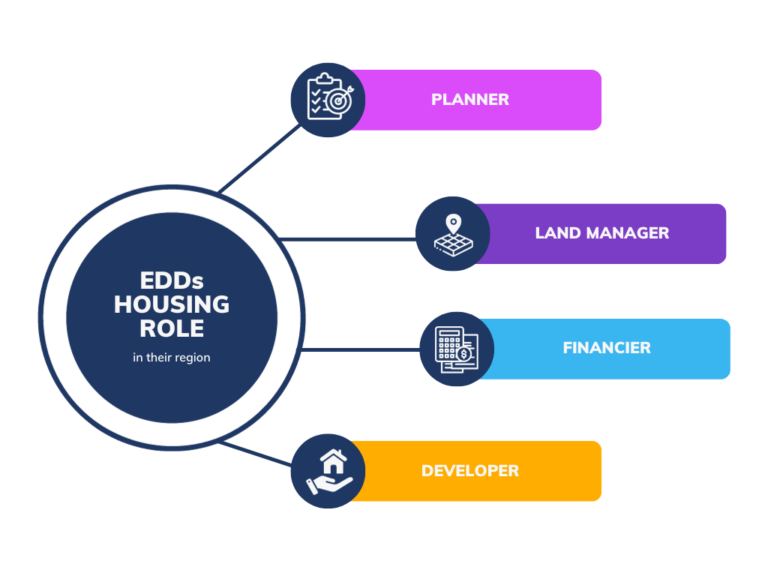
This report will showcase EDD best practices from across the country in a variety of regional market contexts and provide implementable strategies for a variety of different roles that EDDs have taken including Planner, Financier, Land Manager, and Developer. These roles are non-exclusive and many EDDs take on several of these roles already through a variety of different funding mechanisms, staff assignments, and relationships with local stakeholders and state and federal funding agencies and partners. Additionally, this report aims to show how successful EDDs found their voice and role in their respective regional context in order to uplift and inspire other regional organizations that have been unable to find their niche.
EDDs do not typically have direct authority to use the tools municipalities and county governments have to improve housing conditions in their jurisdictions. Tools like levying taxes, scheduling utility rates, developing water and sewer infrastructure, implementing building codes, zoning and land use controls, and providing development incentives are typically out of the scope of EDDs. Lacking the authority to use these traditional tools, EDDs have innovated and are working with local and regional partners to identify the role that will best help their communities address housing challenges, while still meeting the original scope and mission of Economic Development Districts.
EDDs across the country have prioritized addressing housing affordability in response to changing economic conditions in their region and stakeholder input in regional planning groups like the Comprehensive Economic Development Strategy (CEDS) Strategy Committee. In consultation with the SLEDS CEDS Database, 290 EDDs across the country identified housing as a priority for their region’s future economic development through the CEDS planning process. Regions can unite economic development goals and housing goals by viewing the CEDS as an opportunity to tie in issues previously thought to be unrelated. EDDs must begin to conceptualize their region’s housing stock as an economic asset or tool that can be used to support their EDDs mission and scope. Strategies like development of workforce housing for low and middle-income residents to support regional demands for labor, development of housing near commercial districts to reduce travel times and transportation costs, and prioritization of mixed-use design and infill development for targeted economic growth in distressed areas of the region are all examples of how to use a region’s housing stock as a regional economic asset.
While housing affordability is a useful catch-all term, these housing-related problems can manifest in different ways depending on local market conditions. Economic factors like housing supply, rising interest rates, neighborhood composition, access to capital markets, industry diversification, commute patterns, wage growth, regional and local labor shed composition, construction material costs, and supply chain and logistic capacities all affect housing outcomes in regional and local markets. Evaluating these qualitative and quantitative economic data points or market conditions can help stakeholders understand why a regional or local housing market isn’t working for residents on the ground.

This resource is offered through the Economic Development District Community of Practice (EDD CoP), managed by the NADO Research Foundation to build the capacity of the national network of EDDs. To learn more, visit: www.nado.org/EDDCoP. The EDD CoP is made possible through an award from the U.S. Economic Development Administration, U.S. Department of Commerce (ED22HDQ3070106). The statements, findings, conclusions, and recommendations in this resource are those of the author(s) and do not necessarily reflect the views of the U.S. Economic Development Administration or the U.S. Department of Commerce.
For more information about RDOs and housing issues, contact Andrew Coker, Regional Development Researcher, at [email protected].