Case Study: Planning for Food Resilience in East Central Florida
East Central Florida Regional Planning Council(ECFRPC) took a proactive approach to food systems development by using their staff’s planning experience to develop a roadmap for regional and local food systems.
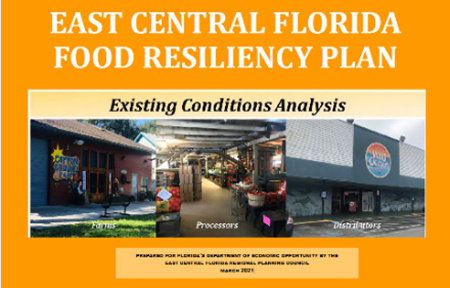
ECFRPC separated their East Central Florida Food Resiliency Plan into an ’Existing Conditions Analysis’ and a ‘Resiliency Trends Analysis’.
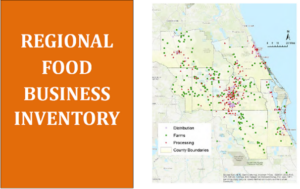
Beginning with the Existing Conditions Analysis, ECFRPC sought to create a baseline for their region by finding the breadth and depth of food systems issues based on conversations with local nonprofit service providers. Highlights of the plan include an inventory of food business assets throughout the region including food production businesses (farms, processors, and distributors) and agricultural land. Then ECFRPC planners mapped the distribution of these assets and developed a series of economic indicators to measure the diversity and extent of the region’s food system. All of ECFRPC’s food system planning work can be found at the East Central Florida Dashboard.
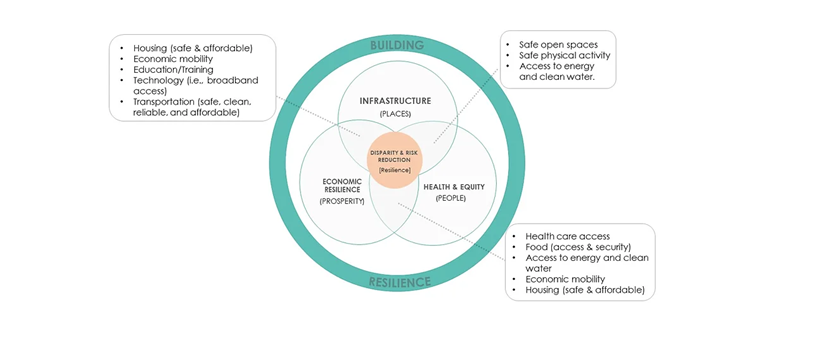
ECFRPC planners used what they learned from the Existing Conditions Analysis to then undertake a Resiliency Trends Analysis that aimed to find emerging market trends they could capitalize on to connect with their regional food system assets. At the center of their definition of community resilience, ECFRPC highlighted recommendations under three categories: People, Places, and Prosperity.
Source: ECFRPC People, Places, and Prosperity Model of Economic Resilience
ECFRPC emphasized the importance of retaining agricultural land in a fast-growing region, where many agricultural parcels (typically owned by local farmers) have been bought up and converted to residential or commercial uses. Retaining these properties as agricultural land maintains a direct source of fresh produce that typically has local entrepreneurial connections.
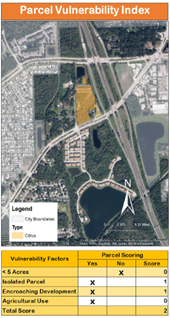
To prioritize agricultural land that is “under threat” from redevelopment or conversion, ECFRPC developed a Parcel Vulnerability Index that identified agricultural land in the region “under threat” based on 4 criteria: type of agricultural use, a parcel being less than 5 acres, isolation from other agricultural land, and with encroaching development.
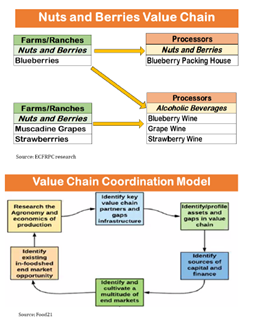
The Resiliency Trends Analysis also highlighted emerging trends in the region. Some findings from the report include the need for more hard infrastructure (like kitchen incubators) and soft infrastructure (technical assistance) to assist food entrepreneurs in scaling up their businesses. Creating more value-added products can also help business owners to generate more economic activity.
Using this information and with assistance from a Steering Committee, ECFRPC developed a road map to improve food system resiliency across the region. Since the project’s completion, ECFRPC has continued to convene their local communities and identified funding sources for implementation of the plan’s recommendations. For example, ECFRPC was recently awarded a $1.5 million EPA Brownfields Coalition Assessment grant. Part of this funding will be used to help Little Growers (an urban agriculture non-profit) develop a ‘Food Entrepreneurship and Climate Action Plan’ for the Booker Heights neighborhood in Melbourne/Palm Bay neighborhood.
The ECFRPC example shows how regional organizations can use in-house planning expertise to help their communities lead change in their region’s food systems. Through economic research and value chain mapping, ECFRPC is identifying areas for improvement in communities and giving them concrete examples of how they can prioritize regional and local food system development.
ECFRPC SIMPLIFIED PLANNING PROCESS
Quantify the extent of the food systems issues in the region and find what parts of the region are in the most distress from food access and affordability issues.
Understand what existing assets a region has in food production, processing, and distribution including businesses, skilled workforce, agricultural land, and support systems.
Help their region and its communities find the gaps in their food systems and value chains.
Build on their existing assets to fill gaps and improve food system resiliency.
Use all the information gathered from the plans to build on and develop new regional assets.
Lessons Learned
Regional Planning for Local Impact ECFRPC planners used their experience in regional planning, their familiarity with the needs of the local community and local markets, and extensive data and mapping to give their local communities the tools needed to build up and support local and regional food systems.
Categorizing Strategies The People, Places, and Prosperity model gave ECFRPC planners and local communities the organization and categorization needed to distill complex food system work down into manageable and useful categories. Each of these categories provides a unique framing of food systems that recognizes the multi-faceted approach needed to make change in a regional food system.