Case Study: Land Bank-ing on Neighborhood Revitalization
Since 2019, Region 1 Planning Council (R1PC) in Northern Illinois has operated a high-volume regional housing land bank for their communities. Spurred on by input from local governments who wanted to do more with vacant or blighted properties in their communities, R1PC established the land bank to meet several housing needs in their region and provide opportunities for redevelopment and neighborhood stabilization in undeserved neighborhoods. Housing in the R1PC region is primarily older single-family houses. As the regional population has declined in past years, the region’s housing stock has deteriorated as residents move or pass away. When residents pass away or move and relatives who live out-of-state retain control of the property, properties can fall into disrepair as the new owners don’t have the desire or funds to maintain or redevelop the property. The regional land bank gives the local governments another option outside of demolition for vacant properties with outstanding tax liens and helps communities turn dormant property into properties that contribute to neighborhood character and annual property tax revenues.
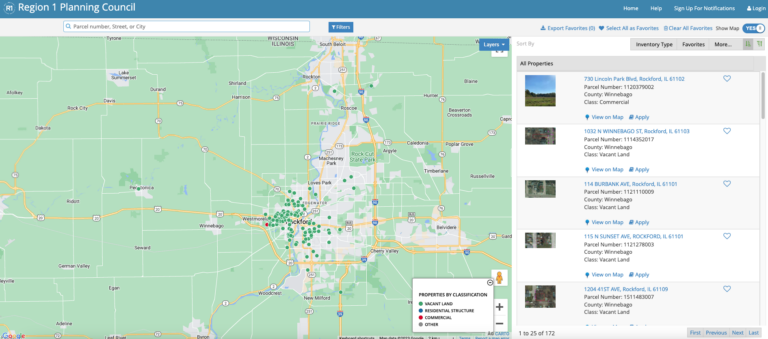
R1PC has streamlined redevelopment of these delinquent properties by hosting properties for sale on an online real estate portal. The portal gives potential buyers the chance to see the property through exterior and interior pictures of any structures, bidding information, and links to county GIS platforms to see the parcel information. Potential buyers can also submit bids for the property through the portal, streamlining the entire process from property acquisition all the way to disposition to a developer or buyer.
R1PC planning staff expressed that the regional nature of the land bank binds their communities together with a shared interest in solving each communities’ housing needs. As the land bank isn’t restricted to one community or county, it can have a larger impact across the R1PC region. Outside of Rockford, IL, the only metro area in the region, the region is primarily rural with under-resourced local governments. The regional organization being the lead organization for the land bank frees up these smaller, more rural cities and counties that would not have the staff capacity to operate a city or county-specific land bank on their own. R1PC staff serving in this periphery management and administrative role makes the land bank more inclusive of the entire region’s communities.
The land bank makes a profit from each project which provides continuing funding support for the program. The cyclical funding model reduces the competitiveness for redevelopment projects between cities or counties within the region. As each project is completed and the property is sold, these additional funds open the door for future projects in other communities. This cyclical funding model allows the land bank to maintain consistent operations across the region and allows R1PC to dedicate consistent staff time to the management of the land bank.