Case Study: Food Security Planning and Collective Impact in an Urban Region

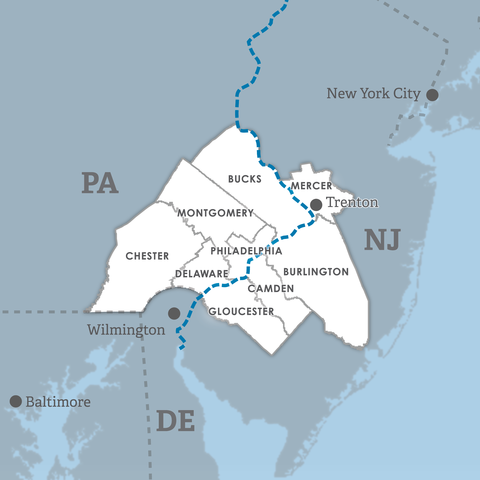
Delaware Valley Regional Planning Commission (DVRPC) is an Economic Development District (EDD) based in Philadelphia, Pennsylvania covering 9 counties across two states (Pennsylvania and New Jersey) and hundreds of municipalities; the EDD has a staff of 1.5 as of 2022, out of a larger staff of over 100. Their primary function continues to be as a federally designated Metropolitan Planning Organization (MPO) focused on transportation and related planning for the Greater Philadelphia region. As an MPO, DVRPC receives funding from a variety of sources, including the Federal Highway Administration, member contributions, and private grants.
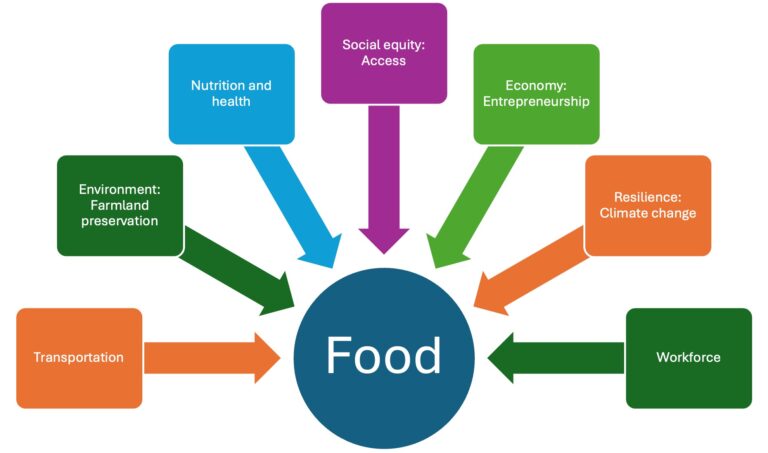
Food systems touch many aspects of the regional economy and in 2007-2008, DVRPC’s MPO planners began to think more about the connection between food systems and transportation. DVRPC planning staff proposed a food system study, the Greater Philadelphia Food System Study (2010), primarily funded through federal transportation funding, which included analyzing the critical role of transportation systems on food systems. DVRPC planners also hoped to better understand the connections between environmental planning and potential farmland preservation plans, social equity through food access, health through nutrition, and the economy through entrepreneurship throughout the Philadelphia metropolitan region. This was one of the first instances of a large planning organization conducting a food system study.
Regional Food System Study and Plan
In 2008-2009, the Greater Philadelphia Food System Study was developed with the goal to understand where food was coming from in the region, how it impacts transportation systems, and what the economic impact was and could be. The study evaluated the natural, economic and social resources of Greater Philadelphia’s foodshed – the 100-mile radius around Philadelphia that serves as the source for much of the area’s food.¹ The supply of agricultural land was compared with demand (see table below), along with threats to local agriculture, competition, health considerations, and the local food movement. Part of that plan involved the development of strategies about what the area wanted its food system to look like, which became the FY 2011 Eating Here.
To build a sustainable and resilient food system, Eating Here outlined recommendations in the following areas:
As a result of this planning, DVRPC received funding from the William Penn Foundation to embark on regranting within the food system with the help of a coalition – the Greater Philly Food System Stakeholders – which was also the advisory committee for these studies. This group worked through 2014, convening, information sharing, and networking as food groups were started – at which point it transitioned into the Healthy Communities Task Force.

City of Camden, New Jersey
In 2015, DVRPC staff completed the Camden Food Economy Strategy. Funded by the Campbell’s Soup Company, the strategy built off Camden’s existing assets by identifying opportunities to increase food access and economic opportunities within the city. It analyzed the city’s current food system and food economy, and acknowledged the challenges that residents face in accessing healthy food. The report recommended growing food as an economic sector, increasing opportunities for food entrepreneurs, engaging Camden’s institutions, and supporting organizations already working to increase access to healthy food, healthcare, and job opportunities. Campbell’s invested $10 million over 10 years in their Healthy Communities initiative with the ultimate goal of reducing childhood hunger and obesity in Camden. Each year, they funded multiple organizations that were working in Camden to address this issue, of which DVRPC was one. Stakeholders including the Food Trust, Food Bank of South NJ, the Campbell Healthy Communities program, The Reinvestment Fund, DVRPC, and others, stayed involved as a collective impact group, continuing to be funded through the Campbell’s support. The collective impact model is a collaborative approach that involves multiple organizations and sectors working together to address complex social issues through five conditions:²
A critical piece of the collective impact model is that all partners are working together toward a common agenda.
The initial Campbells backbone funding of $10 million supported the collective impact group, the Camden Collective of Healthcare Providers, and each of the 10 member organizations received funds to manage their own food systems development projects. The collective impact group met at Campbells Headquarters every month, spurring strong relationships. Competition between the organizations was eliminated thanks to backbone funding to work together. The Camden Food Collective also engages community health workers to connect people to health services through corner stores.
Interesting developments have come out of the Camden Food Security Collective, including best practices like:
A 10-year report showcases the work done through the Camden Food Security Collective as supported by Campbells. Recently, the Camden Coalition stepped down as the backbone and The Food Bank of South Jersey is now filling the role of the lead organization.
CEDS and Food Systems
DVRPC has shown how a large metropolitan EDD/MPO can integrate a variety of its areas of expertise to have an impact on the food system.
Growing Greater Philadelphia, the Comprehensive Economic Development Strategy (CEDS) for Greater Philadelphia was adopted in 2019 and outlines four primary goals: Maximize Human Capital Potential, Attain Regional Growth and Global Connectivity, Strengthen Infrastructure, and Support Inclusive Growth to Empower Communities. Staff included projects within each of these goal areas using the food economy as both a regional and local economic driver.
In 2019, DVRPC staff from the Goods Movement Forum and the CEDS Committee addressed the need to build a resilient supply chain focused on small businesses as strong economic anchors. This forum also addressed the need to strengthen regional infrastructure, particularly the region’s ports and rail systems.
In 2021, DVRPC staff worked closely with staff at the U.S. EDA, Philadelphia region and EPA Region II and III, to develop a multi part webinar series, the Intersection of Food and the Local Economic Development. This webinar series was developed to chart pathways within the emerging sectors of urban agriculture, between small businesses, entrepreneurs, chambers of commerce, and government agencies. Held virtually in March 2021, the webinar series brought in experts from a variety of agricultural sectors, addressing the need to prepare a local workforce in the agricultural sector as well as understanding the need to build a more local food supply to mitigate potential economic shocks (note this was pre-COVID).
Lastly, DVRPC staff were able to ensure the goals of the CEDS and their long-range regional plan were aligned with the development of the Cultivating the Homegrown Economy Tool. This Municipal Implementation Tool (MIT) discusses the shift toward greater support for local economies, local goods and services. This tool define relevant terms to know; identify key attributes and benefits of the homegrown economy; provides specific strategies; and highlights a successful and resilient local economy. Over the past two decades, society has demonstrated a shift towards support for homegrown economies through increased consumer prioritization of local goods and services. This tool highlighted the elements of successful local economies-appreciation of resources, citizen participation, government leadership, and inter-community cooperation. This tool directly addressed strategies and objectives related to building strong communities, as outlined in the CEDS.
Lessons Learned:
¹ Eating Here: Cultivating a Robust Food System in Greater Philadelphia. https://www.dvrpc.org/reports/10063a.pdf.
² Collective Impact Forum. What is collective impact. https://collectiveimpactforum.org/what-is-collective-impact/
³ Collective Impact Forum. What is collective impact. https://collectiveimpactforum.org/what-is-collective-impact/