
Food Systems as Regional Economic Development
Improving access to affordable, nutritious food is an obvious public health benefit. However, many fail to consider how regionally and/or locally controlled food systems can be an economic asset for building and retaining wealth. EDDs should work to create the planning, financing, workforce, and business support conditions needed to create and retain food system assets in communities.
Several U.S. Department of Agriculture (USDA) research studies commissioned over the past 20 years show that local food systems can have an outsized economic impact on their local communities relative to the amount of investment initially made by local or state governments. Low et al. (2015) compiled a comprehensive literature review of several economic impact studies done on regional and local food systems which provide key evidence that consumer demand for locally produced foods is growing¹. National sales from direct marketing channels of local foods grew from $511 million in 1997 to $8.7 billion in 2015 ¹. A University of Wisconsin-Madison study, in partnership with the Food Market Coalition, found that 2.2 jobs are created for every $100,000 in local food sales.
Having food value chains rooted in communities can create new avenues and opportunities for local entrepreneurs to build their businesses and make connections with other locally owned businesses. Building these relationships can create a web of interconnected entrepreneurs whose local networks can reduce logistics costs, provide higher quality services to customers, retain value in communities, and support new jobs.
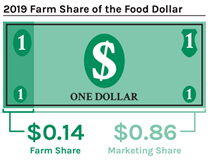
Source: Agriculture and Local Food Economies in the Appalachian Region, prepared by Karen Karp and Partners (KK&P), in partnership with the Appalachian Regional Commission (ARC) (2022).
The above graphic displays the relationship between producers and other levels of the food supply chain with farmers receiving only $0.14 of every $1 spent on food in the U.S.$0.86 of every $1 spent on food in the U.S. is then earned by the marketing portion of the supply chain. Shifting this ratio towards a higher share of each dollar reaching local producers should be one of the main focuses of EDDs’ work to support the development of regional and local food systems. As local and regional food systems are strengthened, more local food system entrepreneurs are supported, and more producers, distributors, processors and retailers are rooted in these communities and regions, a larger share of that $1 spent on food will remain in those communities.
Food systems are a valuable area for investment as they have vast multiplier impacts on local jobs and local private investment beyond the market, farm, or processor. A USDA study found that local food systems have an economic multiplier on jobs of 1.78-1.41, meaning that for every job created in local food systems, an additional 0.78 to 0.41 jobs are created in other economic sectors in the region. Schmit et al. (2013) found that local food hubs can have an economic multiplier impact ranging from 1.82 to 1.63 for every dollar invested ². Local and regional food hubs will be discussed in later sections. In a 2021 study conducted by Tennessee State University with support from USDA, researchers found that local food systems in Tennessee have an average income multiplier of 2.56 and a value-added multiplier of 2.06 ³. These numbers are only expected to grow as consumer demand for locally produced foods continues to grow across the country.
These multiplier effects make ‘import substitution,’ the consumer habit of sourcing goods from local sources instead of importing the same good from other areas, all the more important for growing regional and local economies. Greater demand for these goods creates the economic conditions necessary for those regionally or locally owned producers, processors, and retailers to expand and grow their businesses in communities. Successful regional food systems provide benefits to both rural and urban areas. Higher demand for locally produced goods in rural and urban areas further strengthens regional economic connections between rural areas and urban areas of a region, shifting needed capital and private investment towards rural areas. This is the crux of regional wealth creation that will be discussed in future sections.
¹ Low, Sarah A., Aaron Adalja, Elizabeth Beaulieu, Nigel Key, Steve Martinez, Alex Melton, Agnes Perez, Katherine Ralston, Hayden Stewart, Shellye Suttles, Stephen Vogel, and Becca B.R. Jablonski (2015, January). Trends in U.S. Local and Regional Food Systems, AP-068, U.S. Department of Agriculture, Economic Research Service. https://www.ers.usda.gov/webdocs/publications/42805/51173_ap068.pdf?v=2018.5
² Schmit, T.M., B.B.R. Jablonski, and D. Kay.(2013, September). “Assessing the Economic Impacts of Regional Food Hubs: the Case of Regional Access.” Cornell University. http://dx.doi.org/10.9752/MS145.09-2013
³ Ajayi, O., Ekanem, E., & Mafuyai, M. (2021, March). Economic Contributions of the Local Food Systems in Tennessee. https://www.fdrsinc.org/wp-content/uploads/2021/05/JFDR52.1_4_Ajayi.pdf