Disaster recovery and resilience policy is undergoing a major transformation as federal agencies rethink how recovery funds are distributed, new funding partners emerge, and communities are asked to do more with limited resources. For Economic Development Districts (EDDs), navigating this evolving landscape presents both challenges and opportunities.
At the 2026 Economic Development Training for the EDA Atlanta Region held in July 2026, the NADO Research Foundation hosted an interactive pre-conference workshop facilitated by Josh Human (Director of Resilience, Plummer) and David Dodd (CEO, International Sustainable Resilience Center). The session explored the evolving role of EDDs in disaster recovery and resilience, including identifying regional vulnerabilities, coordinating with regional partners, aligning Comprehensive Economic Development Strategies (CEDS) with hazard mitigation planning, promoting business continuity planning, and leveraging funding opportunities. Participants gained practical insights into how policy and funding shifts may reshape long-term recovery timelines while creating new opportunities to better align recovery efforts with broader economic development goals.
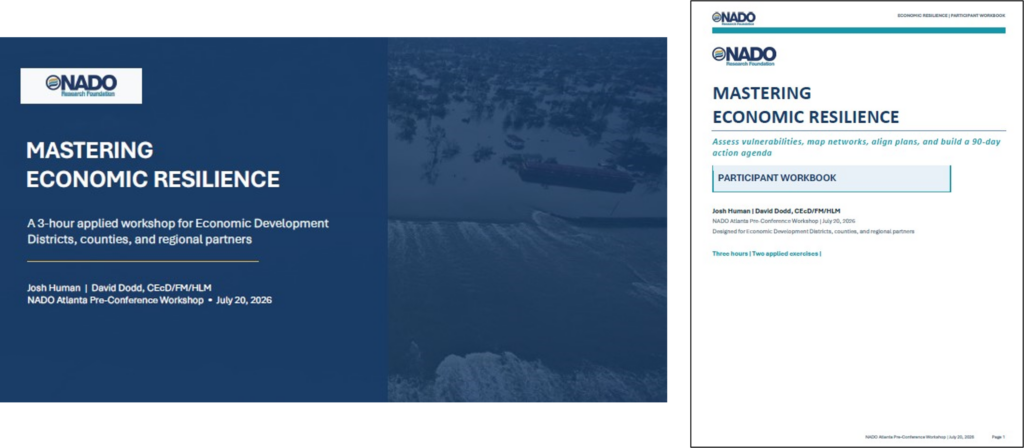
The presentation slides and accompanying workbook (PDF) are now available for a wider audience. These resources are relevant for staff at any EDD seeking to assess vulnerabilities, map regional networks, align planning efforts, and develop a 90-day action agenda to support regional preparedness and strengthen economic resilience. While the workbook references specific slides from the presentation, the two resources can be used either together or independently.
This session was offered through the Economic Development District Community of Practice (EDD CoP), managed by the NADO Research Foundation. To learn more, visit www.nado.org/EDDCoP. The EDD CoP is made possible through an award from the U.S. Economic Development Administration, U.S. Department of Commerce (ED22HDQ3070106). The statements, findings, conclusions, and recommendations offered are those of the speakers and participants, and do not necessarily reflect the views of the U.S. Economic Development Administration or the U.S. Department of Commerce.