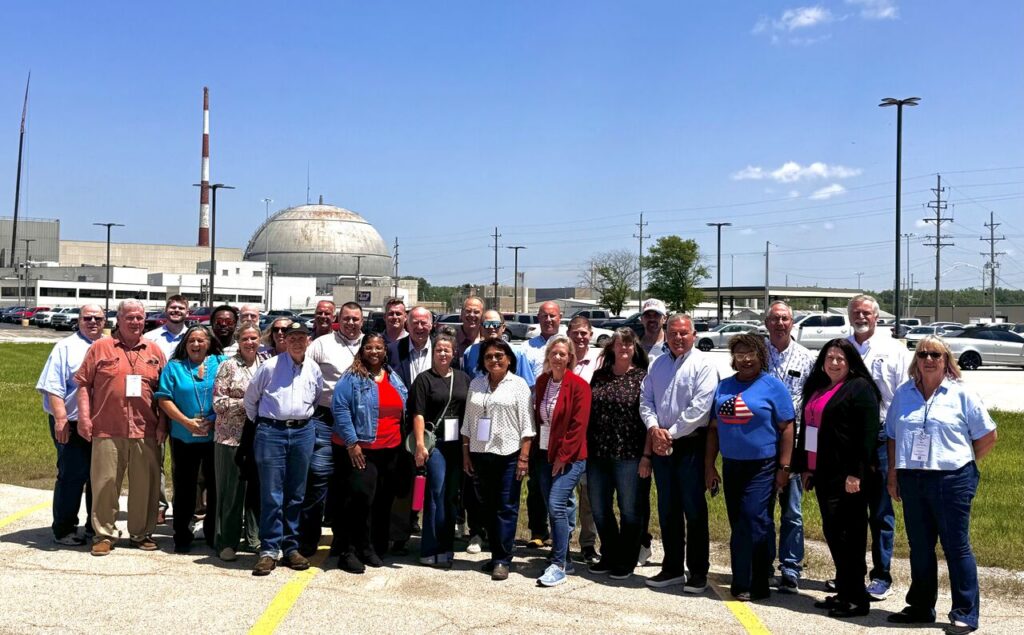
From Monday, June 29 through Wednesday, July 1, 2026, the National Association of Counties’ Rural Energy Academy (REA) hosted a peer exchange in Grundy County, Illinois, bringing together county leaders from across the country for site visits and briefings centered on two pressing energy technologies facing rural communities today: nuclear power and Battery Energy Storage Systems (BESS). Ethan Simon, NADO Research Fellow, attended the three-day peer exchange, which examined how one county has spent decades hosting nuclear infrastructure, the advancement of nuclear energy, and how communities nationally are faced with decisions about newer, less familiar technology in BESS.
Why Grundy County?
While Illinois is often known as the Land of Lincoln, a national agricultural powerhouse, and for Chicago’s skyline, it also produces more nuclear power than any other state in the nation. And it is not slowing down: the Clean and Reliable Grid Affordability Act, passed in January 2026, lifted a moratorium on new large nuclear reactors in Illinois that had been in place since 1980. This is critical, with data centers driving significant new demand for electricity, nuclear power is increasingly viewed as an optimal tool for supporting load growth with clean, reliable energy that carries a higher capacity factor, requires less maintenance, and uses far less land than other generation sources.
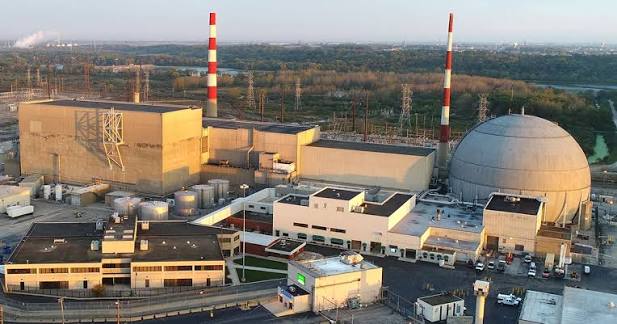
Grundy County, located in North Central Illinois, was selected to host the peer exchange because it is home to the Dresden Clean Energy Center, the nation’s first full-scale, privately financed nuclear plant and a cornerstone of the local economy. The station employs more than 700 people, most of whom live in Grundy and nearby Will Counties, with an annual payroll of roughly $74 million. Dresden alone pays approximately $26.5 million in annual property taxes. That decades-long track record of hosting major energy infrastructure, including its proximity to the nearby LaSalle County Nuclear Generating Station and Braidwood Nuclear Generating Station, located in LaSalle and Will Counties respectively, made Grundy County an ideal classroom for county leaders seeking to better understand nuclear energy. to better understand nuclear energy.
Illinois Nuclear Champion: Senator Sue Rezin
Hon. Sue Rezin, Deputy Minority Leader of the Illinois Senate and longtime representative for the Morris area, gave county leaders a legislator’s-eye view of how Illinois preserved and expanded its nuclear fleet. Rezin, who has represented the district for roughly 16 years, described helping shepherd the legislation overturning the state’s four-decade moratorium on new large nuclear plants through the Senate as a member of the super-minority, including working to override a gubernatorial veto. She noted that Illinois remains a net exporter of nuclear power and holds the largest nuclear fleet in the country and pointed to rising electricity costs as demand climbs while gas and coal capacity is retired. A particularly interesting legislative initiative that Rezin explained was that under current Illinois rules, she explained, a developer seeking 1,000 MW of new capacity must pay for it upfront, a policy detail with real implications for how quickly new generation can come online.
Nuclear Energy Explained: An Argonne National Laboratory Brief
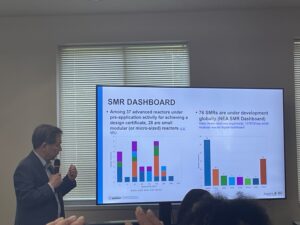
Taek Kyum Kim, PhD, Department Manager for Nuclear Systems Analysis at Argonne National Laboratory, gave participants a foundational grounding in how nuclear reactors work and how safety has evolved from Generation I through Generation IV designs. He used the three most-cited severe accidents, Three Mile Island, Chernobyl, and Fukushima, to illustrate what happens when a reactor’s layered safety systems fail in different ways and described a landmark 1986 Argonne test showing its EBR-II reactor could safely handle a station blackout without any operator intervention. Looking to the future, he highlighted that small modular reactors offer lower costs, faster construction timelines, and unlock new jobs, economic, and environmental opportunities. Dr. Kim ended by citing a Department of Energy study that looks at chemically recycling used fuel to extract leftover energy, thus going away from the once-through cycle that US currently uses, cutting waste volumes and improving uranium utilization.
Economic Development, Workforce, and Community Benefits
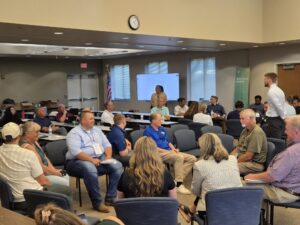
Brad Clark, Director of Education for the Rural Energy Academy led a panel on navigating the economic and community side of energy development, emphasizing proactive engagement early and often and clarity around the roles different stakeholders play, from elected officials and economic developers to horizontal and vertical developers, off-takers, and hyperscale tenants. He walked through how construction budgets typically flow into infrastructure like roads, transmission, and water treatment, as well as workforce training and expanded emergency services, while operational budgets support ongoing taxation, workforce and education needs, environmental outcomes, and community priorities such as energy affordability and housing. Nancy Norton then shared Grundy County’s own story as a nuclear host community for 66 years. Despite headwinds like low natural gas prices and shifting FERC rules, nuclear power remains an economic powerhouse for the county, with Dresden alone accounting for 6.7 percent of Grundy County’s labor force and generating indirect employment gains in maintenance, construction, professional and technical services, and local restaurants.
Rounding out the panel, Mark Pavlis, Secretary-Treasurer of the Laborers’ International Union of North America (LiUNA) Local 75, which represents workers across Will and Grundy Counties, spoke about the importance of building a pipeline for recruiting, training, and placing skilled tradespeople, highlighting LiUNA’s Chicagoland Apprenticeship Program as one model for preparing the workforce that energy projects increasingly require. Following the panel, participants broke into small groups with the speakers to learn more and how to bring this information back to their own counties.
Touring the Dresden Clean Energy Center
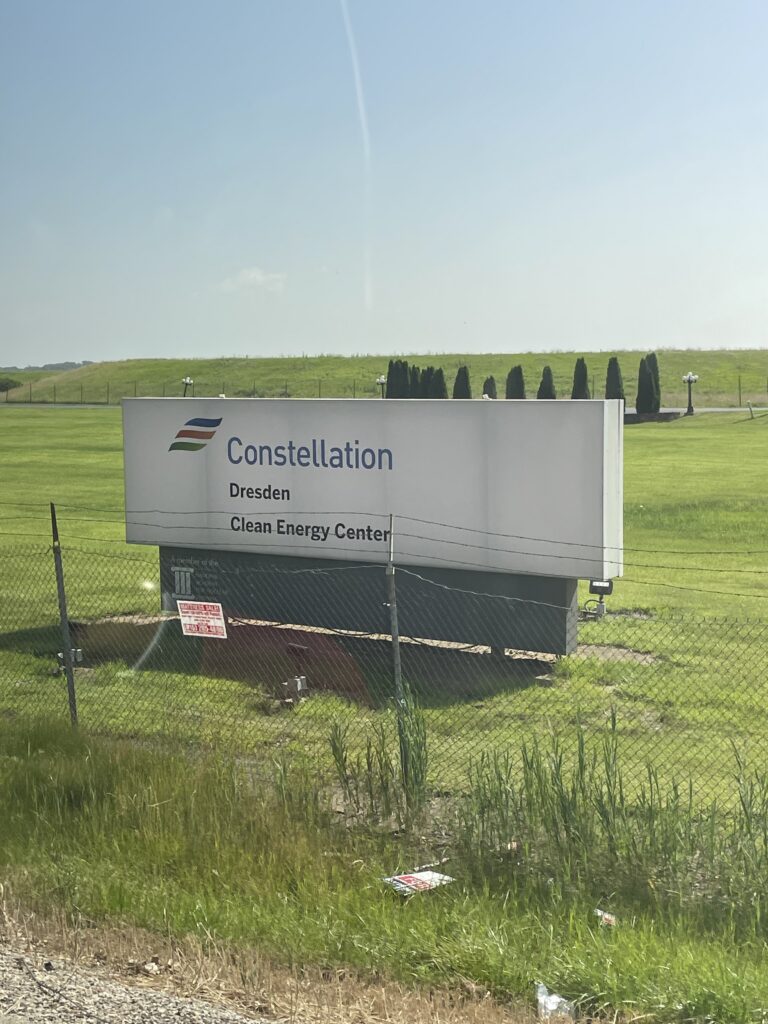
Participants traveled to the Dresden Clean Energy Center in Morris for a tour hosted by plant owner and operator Constellation Energy. Due to extreme heat, the plant limited access to the operating floor, however participants toured a simulator control room built as an exact replica of Dresden’s Unit 2 control room. Constellation staff demonstrated how operators manage electricity, water, and control rods, guided the group through a simulated reactor shutdown (“scram”), and explained the extensive safety procedures that require at least 56 hours before a reactor can restart. Staff also highlighted a partnership with a local junior college that prepares area high school students for careers at the plant.
Dresden’s two boiling water reactor units each generate 900 MW and run on a two-year refueling cycle, with one unit refueled each November; together they typically operate over 94 percent capacity for eleven months of the year. Constellation operates six nuclear plants in Illinois in addition to facilities in New York and Pennsylvania, including Three Mile Island which is slated to reopen under a new name in 2027. Constellations the largest producer of carbon-free energy in the country, supplying roughly three-quarters of Fortune 100 companies and about 10 percent of the nation’s carbon-free electricity.
An Interesting Question: What Happens to Nuclear Waste?
Participants also learned about the plant’s approach to spent fuel, which is stored in dry casks on-site inside steel or steel-reinforced concrete containers with walls up to 35 inches thick, housed aboveground in reinforced concrete pads or bunkers, designed to safely store fuel on-site throughout the facility’s expected 80-year operating life. Many have heard about Yucca Mountain in Nye County, Nevada, designated in 2002 as the nation’s only planned deep geological repository for spent nuclear fuel. Decades of delays and funding gaps have kept the site from ever opening, leaving the question of permanent storage unresolved even as interest in nuclear power grows. Finland offers one alternative model: the country has built a repository more than 400 meters underground on the island of Olkiluoto capable of storing up to 6,500 tons of spent fuel, sealed in canisters designed to remain in place until radioactivity decays to safe levels, with the facility expected to operate until at least the 2120s before final closure. As nuclear power continues to expand, long-term waste storage will only grow as a policy issue that counties, states, and the federal government will need to address together.
Alongside nuclear power, a significant portion of the peer exchange was devoted to Battery Energy Storage Systems – a technology that stores electrical energy from a generator for use later, capable of drawing from either conventional or renewable sources to balance generation and demand in real time.
Battery Storage Fundamentals with Argonne National Laboratory
Dr. Jianlin Li, Director of Energy Storage and Conversion at Argonne National Laboratory, gave participants a technical synopsis of the science of battery storage, comparing the tradeoffs of lithium-ion, lead-acid, and flow battery chemistries and previewing emerging technologies like sodium-ion and solid-state batteries. He also addressed the community-facing side of BESS siting, weighing benefits like reduced reliance on peaker plants and lower electricity bills against risks such as thermal runaway, toxic emissions, and noise. Dr. Li ended by noting the new community wellbeing and safety benefits of BESS like NFPA 855 ensuring protection against fires, new noise mitigation technology and the positives of having 24/7 renewable power. noting that code such as NFPA 855 are increasingly built into projects to address those concerns.
Inside the Emergency Operations Center
Participants next heard from Joe Schroeder, Director of the Grundy County Emergency Management Agency, who explained how the county’s Emergency Operations Center coordinates disaster prevention, preparedness, response, recovery, and mitigation across Grundy County. Because Dresden sits within county boundaries, the agency maintains a dedicated plan for radiological accidents and offers Radiological Emergency Preparedness training in partnership with the Illinois Emergency Management Agency, in addition to its more routine responsibilities like traffic control and scene lighting during emergencies.
Case Study: Linn County, Iowa’s BESS Ordinance Journey
Charlie Nichols, Director of Planning and Development for Linn County, Iowa, shared how his county turned a contested BESS project –a 1,100-plus-acre solar and storage development proposed on the site of the decommissioned Duane Arnold Nuclear Facility –into a repeatable planning process. Facing significant public opposition, the County Board paused new solar applications and formed four focused review committees, whose advisory statements staff translated into workable ordinance language. One particular concern was looking at the issue of what must be shown before approval of BESS. Nichols demonstrated how Linn County proved that the public could help define this question by identifying the impacts that matter locally and the information that is missing. The final transferable question became “what information do we need before approval, who reviews it, and what duties continue after approval.” By working with the public, this question can support ordinance updates, project-specific application review, or a comprehensive plan update all while creating a repeatable process Linn County can now apply to other complex land uses.
What Community Leaders need to know about BESS Planning and Siting
Upasana Roy, Land Use and Energy Planner with the Great Plains Institute, reframed BESS not as a fundamentally new land use, but as one that shares many attributes with energy storage facilities communities already accommodate. She noted that Illinois’s Clean and Reliable Grid Affordability Act requires counties with conflicting BESS zoning ordinances to the act to amend them within 120 days and sets a statewide target of 3,000 MW of cumulative BESS capacity by the end of 2030. Roy walked through the benefits of BESS, Illinois’ technical siting standards, including setbacks, fencing and noise limits, and the safety codes like NFPA 855 and UL 9540/9540, that govern BESS installations. Further, Roy touched on environment concerns like thermal runaway, water and soil contamination, and gaseous contamination. Finally, she stressed that decommissioning plans backed by financial assurance should be required at the time of application, not left for later and that the land of the site should be restored within a defined timeframe.
Federal Energy Policy Update
Charlotte Mitchell Duyshart, Associate Legislative Director, Environment, Energy, and Land Use at NACo, gave a brief rundown of the federal energy policy landscape. She highlighted the Federal Energy Regulatory Commissions June 18 show cause orders directing six regional grid operators to reexamine their rules for large-load data centers interconnections, several data center-related bills moving through Congress and NACo’s support for permitting reform through the SPEED Act and CERTAIN Act. She closed by noting that clean energy tax credits, nuclear, geothermal, and battery storage remain the federal government’s core priorities heading int the rest of 2026.
Over two and a half days, the Grundy County Peer Exchange gave county leaders something hard to get from a report or a webinar: a firsthand look at what it takes to host energy infrastructure. Grundy County’s 66 years alongside Dresden showed what a mature, well-understood host relationship can look like, while the deep dive into Battery Energy Storage Systems, still new to many communities, gave participants a practical framework for getting ahead of a technology that is still arriving in counties nationwide. As the energy landscape continues to shift, a peer exchange such as this offers core lessons for participants to carry home to their communities.
Additional speakers at this site visit: Chris Brown, Mayor of the City of Morris; Drew Muffler, Grundy County Board Chairman; Shelby Butz, Associate Program Director, Environment and Land Use at NACo; Blake Gardiner, Program Manager, Clean Energy at NACo; and Ethan Simon, Research Fellow at NADO.
Further Reading: