Tribal Engagement Strategies
Introduction
Economic Development Districts (EDDs) and American Indian and Alaska Native Tribal Nations frequently represent overlapping or adjacent geographies, which often leads to a shared interest in regional economic development topics. However, the extent of relationships between EDDs and Tribal Nations varies widely across the United States. Some have deep and enduring partnerships, including official Tribal representation as EDD members or on the organization’s board of directors. In other places, Tribal Nations and EDDs have a limited history of collaboration or official contact. Many EDD staff report that they wish to expand their relationships with local tribal nations. However, they are often unsure how to respectfully involve these partners in established planning and implementation processes. This brief outlines opportunities for EDD-Tribal collaboration, as well as tips for EDD staff seeking to initiate relationships with Tribal Nations. It highlights the value of looking at economic development holistically and inclusively.
Background: Tribal Reservations in the United States
The legal framework that governs relations between the U.S. Federal Government, U.S. states, and American Indian or Alaska Native Tribes is complex, encompassing varying legal duties, moral obligations, and informal understandings and expectations shaped over the course of the 250-year history of the United States. The U.S. Government presently recognizes 574 American Indian and Alaska Native tribes and villages, and 326 Indian Reservations. Not all federally recognized Tribes have an associated Reservation, though some Reservations are held in trust by more than one Tribe. U.S. states recognize approximately sixty-five additional Tribes. State recognized Tribal Reservations differ from federally recognized reservations in that they are typically subject to all state laws but exempt from state property taxes.1
As recognized sovereign nations, Tribes govern with all powers of self-government except those relinquished under treaty, by Congressional statute, or by federal court ruling. Tribes may form independent governments, establish taxes, make and enforce laws, license and regulate economic and other activities, determine standards for tribal citizenship, and exclude unwanted persons from their lands. They may also enter into government-to-government agreements with the U.S. Federal Government, states, localities, and other public entities Not all tribally owned land is held on Tribal Reservations. Fee lands, for example, are property owned by tribal members that can be freely bought and sold like any other parcel in the United States. The conversion of fee lands to trust lands, or the inverse, has been the subject of significant and complex actions over the last 150 years and has major implications for tribal economic development. This Congressional Research Service report analyzes this issue in some depth. It is critical for EDDs who wish to partner with Tribal entities to understand the legal rights, duties, and responsibilities entailed by Tribal Nation sovereignty, as well as the centrality of Tribal sovereignty to questions of identity and belonging in Indian country and the United States. Though it is not necessary to become an expert, a strong working understanding and respect for the complexity and gravity of this framework can help EDD staff begin to establish trust with potential partners.
Background: EDD-Tribe Relationships
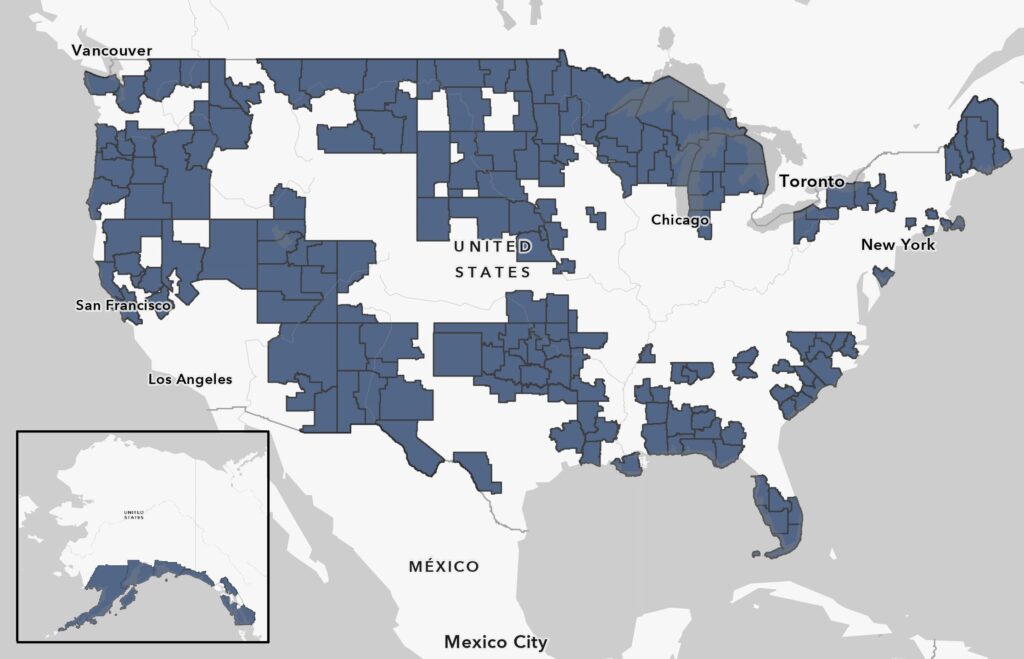
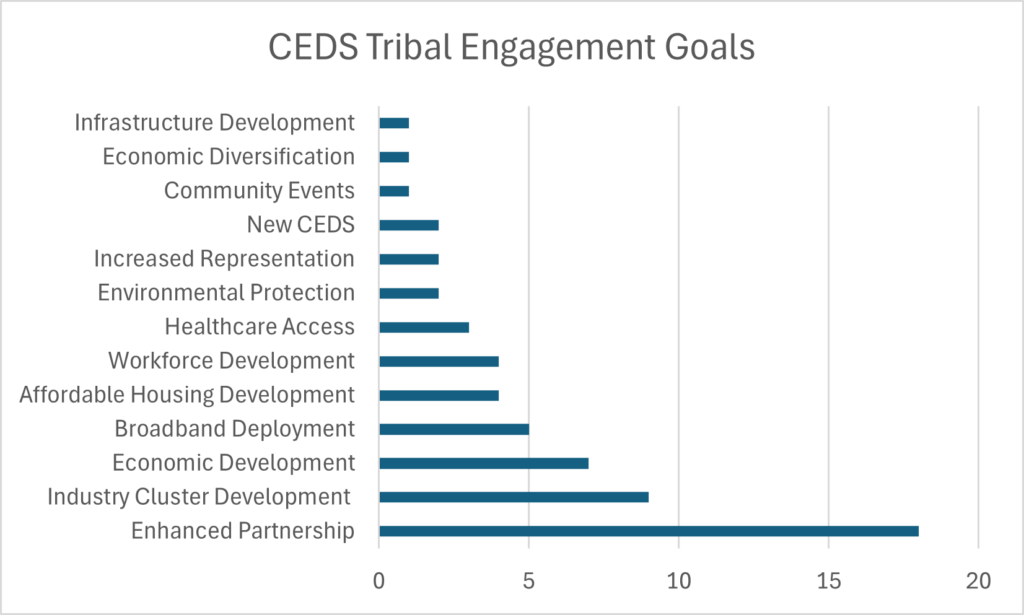
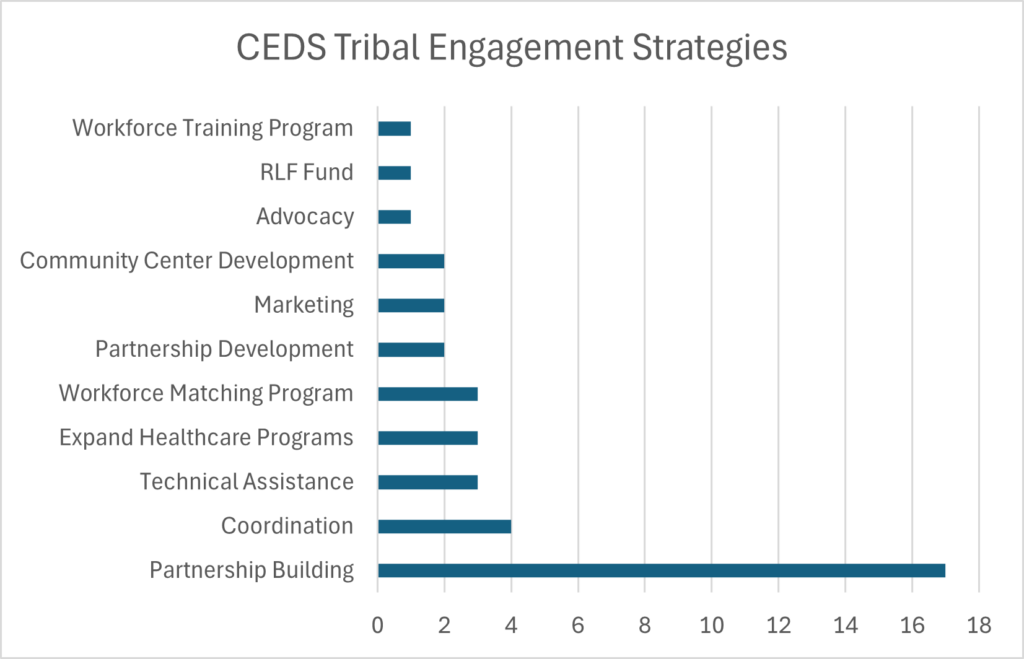
The U.S. Economic Development Administration (EDA)’s Planning Program requires that all partnership planning grantees, EDD or tribal, write and maintain an individual Comprehensive Economic Development Strategy (CEDS). This includes EDDs and Tribes with overlapping boundaries. Each of the approximately 400 EDDs and number of Native American/Alaska Native Planning Grantees maintains an individual CEDS outlining their five-year program of economic development goals and activities. More than 150 EDDs have service areas that overlap with Tribal Reservation, Off-Reservation Trust Lands, or Oklahoma Tribal Statistical Areas, and dozens more share at least one border. In some cases the overlap is substantial; for example, more than half of the Northern Arizona Council of Governments’ service area overlaps with Navajo Nation boundaries. Still, the two each complete their own CEDS. Dozens of EDDs have existing relationships with tribal entities in and around their service areas to promote and enhance regional economic development. The extent of these relationships ranges from informal contact at the staff level to tribal representation as EDD members or on an EDD board of directors. For example, the Southeast Conference based in Juneau, Alaska includes several tribes and Alaska Native associations among its membership, and the Principal Chief of Osage Nation sits on the Board of Directors of the Indian Nations Council of Government, an EDD serving the Tulsa, Oklahoma region. A recent Economic Development District Community of Practice (EDD CoP) survey of EDD Executive Directors and review of 402 recent CEDS plans across the country found that at least 70 EDDs have existing relationships or are seeking to build relationships with local Tribal communities. Tribal members often sit on EDD CEDS committees, or partner on specific projects like broadband deployment, RLFs, hazard mitigation planning, and food ecosystems development. A number of EDDs have offered technical assistance to Tribal Nations for their CEDS process or other planning efforts. The two charts below display a snapshot of goals and strategies for tribal engagement voiced in CEDS plans.
There is also frequent government-to-government consultation between EDDs and Tribal Nations for projects that invoke National Historic Preservation Act (NHPA) or National Environmental Policy Act (NEPA) Section 106 reviews. Section 106 requires that agencies identify historic properties, assess effects to historic properties, consider alternatives to avoid, minimize, or mitigate any adverse effects, and document their resolution, including through a stakeholder engagement process with Indian Tribes, among others.
Planning Context
As noted above, many EDD service areas overlap with Tribal Reservations. Beyond overlapping administrative boundaries, tribes play a critical role in the formation of regional cultures and economies. Transportation infrastructure, freight flows, people, wildlife, and services cross freely over these lines, collectively creating regional economic activity and physical, cultural, and ecological dependencies. Because of these interdependencies, siloed efforts amongst EDDs and Tribal Nations cannot result in truly comprehensive regional plans and can lead to missed opportunities, overlapping programs, and unrealistic analyses of regional needs. At worst, they could result in the pursuit of projects or strategies that are at cross-purposes. The situation also precludes the possibility of fulsome and equitable public engagement for projects and programs of regional significance. In contrast, regional cooperation between tribes and EDDs can create force multiplier effects, where the resources and opportunities of adjacent areas feed into and build on each other. BUILDING COMMUNITY The interests that Tribal Nations represent are not merely economic in nature but include nurturing the social and cultural flourishing and continuation of their communities, histories, and traditions. As such, outreach to these communities should consider holistic approaches and highlight shared goals beyond simple economic impacts. At their core, EDDs are convening organizations that bring people and communities together to solve complex regional challenges. Creating communities of trust and mutual understanding is critical to that mission, both for specific projects and for the long-term resilience of regions and places. While all the tips and tools in the following section are important, it is critical that community is at the center of this work.
With this context in mind, the following is a list of engagement tips for EDDs looking to start (or renew) a relationship with Tribal Nations in or adjacent to its service area. These tips were sourced from staff at EDDs with strong Tribal relationships as well as from experts on Tribal engagement in the EDD Community of Practice team and from federal partners.
Tips for Outreach